Benjamin – Blog Post #10

Before I wrapped up my blog with a slight reflection on the course itself, paired with my own thoughts on gaming and gaming communities I wanted to speak one last time on the subject of my final research paper. When ending my paper I noted some facts about race, and also went slightly in depth mid paper about the players mother as a character. I felt these two topics are possible areas where I could expand on the paper in the future, particularly while showing how the player’s mother is always a nurturing symbol within the games, whereas the one father we have is a powerful gym leader who shows “leadership”. Race and Gender are two topics in the Pokemon universe that I feel me and many other fans often have overlooked as we care so little for NPC’s and rather focus on when our one Pokemon will finally evolve so we can dunk on our rival. Still, I think the interactions with NPC’s and why Game Freak chose certain dialogue, and roles for certain characters is worthy of a closer analysis in the future, and hope to one day see more criticism related to the topic. 

As for my final thoughts, as with my last post I find myself a bit sad in that this course has finally come to a close. I have never taken a Media Study course, and being an English major I must say the entire course has been a great breath of fresh air. Cody has been an amazing Professor and has truly cared about his students during these troubling times. And though I wish I could have experienced the course at its fullest in person, the transition has been handled so well by all included in it. I’ve enjoyed watching streams, videos and playing along with each other on the Discord server, and most importantly I’ve learned something. I’ve learned a great deal about game communities, and the flaws of the gaming world, while also finally viewing it in a positive light despite these negatives and flaws. Growing up I always saw gaming as something bad, something that shouldn’t be a focus of anyone’s life, or even the focus of an hour in someone’s day. But in the last few years I’ve grown more comfortable dedicating more and more of my time to gaming, especially with friends. 

And, most importantly I feel this course really led me to think outside the box. I think one of the most interesting videos and aspects of gaming we went over was those enshrouded in “GamerGate”. After the in class discussion we had that day after watching the youtube video I sent the video to a group of my friends, and debated some of the responses that came from it and some of the interesting things the youtuber had said. I found it interesting that we had this discussion in a gaming community, on discord, of a pretty substantial size, and yet only me and my friends chose to discuss the topic. Never had I seen the topic arise outside of when we had discussed it, nor had we ever discussed the hardships of girl gamers and how certain people are targeted in gaming communities. Also of note was the absence of the members who seemed truly so interested in gaming, certainly more interested than me. It would seem that so many fans of particular franchises, stories and games are passionate when it comes to discussing said games and franchises, and perhaps even argumentative, but when discussing the hardships of others in relation to those games or to the gaming community as a whole the voices are less loud. Either way, I enjoyed the discussion the video led to, and we also analyzed the two videos that followed it for hours of that day. It was enlightening, and eye opening and made me see many faults within gaming communities as well as the one I was a part of. Despite seeing the faults though I saw so much good from others responses to it, particularly those closer to me, and learned more about their views toward the subject and how they coincided with mine. I will never forget that experience, and that’s more I can say most of my classes have led to when it comes to considering their information outside of the classroom itself.

Benjamin – Blog Post #9

I just submitted my final research project for the course, and though I feel as though a large worry has subsided I also feel a bit…empty? While writing the research paper I felt very passionate for what I was writing, as Pokemon has always influenced my thoughts and emotions since I was a young child. It always hurts to admit something we love is flawed, but I’m thankful the day I realized many of the great problems the franchise had it was not through my own critical view, but rather Game Freak putting their faults on display front and center. Upon finishing this paper I wished I could continue on, and have considered it for a brief moment or two (had I not written more than forty pages in the last week or so I would consider it a bit more strongly). I feel as though the Pokemon Universe is ginormous, and as such has a lot of faults. Like all good games, its positive attributes outnumber its faults, and though we could certainly question whether it is deserving of praise in the first place I would rather focus on the few faults within the franchise so few look at.

In my last post I spoke of the customization system in X & Y and Sword and Shield, and I fleshed out this idea in my paper more so. However, I wanted to add onto what I said in a less formal environment. What’s truly interesting about customization systems being introduces is that it should by all means take away the player character’s existence as a protagonist. Meaning, by all means Serena should not exist in the anime, nor Calem, or whoever the h*ck the  protagonists are from Sun and Moon. And yet they do. Pokemon continues keeping these characters, and giving them personality through its anime, manga and other media while giving players the option to customize their player character to suit their own tastes and looks. With the initial addition of the customization system to Pokemon X & Y there was also certainly some backlash, in that males received substantially less options than females did when it came to clothing, styles and accessories. With time of course would come a far better customization system in Pokemon Sword and Shield, and yet the three games that came in between that time had no customization system at all. Its strange to me that Game Freak and the Pokemon Company as a whole would abandon such a feature as they added nothing to replace it, and as a result likely led many players to feel less immersed and less interested in their character as a whole.

But, ultimately Pokemon Sword and Shield came along with a fully customizable character. Customization options in game feel endless, and it is one of the best “new” features ever added to a Pokemon game, in my opinion. There are plenty of clothing options, and female characters only receive ten percent more options in comparison to their male counterparts. Though there are certainly many other issues with the games their customization system is pretty up to par with current games and I can only hope that they continue to offer it in future games, while offering more and more changes to player characters to better suit the players who use them.

Benjamin – Blog Post #8

I wrote this blog post halfway through my research paper draft, I think it’s really coming along with the idea of immersion. I wanted to share my introduction and what it is planned to lead to. Here is an excerpt:

“It was almost twenty five years ago that Pocket Monsters: Red and Green hit the shelves of video game stores in Japan. February 27th, 1996 marked the day in which the Pokémon series began with this historic release. Originally the game promised a role-playing experience, developed by Game Freak and published by Nintendo, with plenty of adventures to be had alongside monster-like creatures that you, the player befriend. It was not until 1998 and 1999 that we saw Pokémon Red and Blue Versions release in North America as the franchise continued to grow in popularity. Today the Pokémon franchise has grown to become the highest grossing media franchise of all time with a record $90 billion in total revenue, while also being the second-best-selling video game franchise to date, only being topped by Nintendo’s own Mario franchise (Burwick, 2018). Despite these achievements the franchise has always struggled with its interpretation and portrayal of gender. Options have been limited, and changes have been few and far in between.” 

This Day in Gaming History: A Wild Pokemon Appears | The Sociology ...

This introduction I plan to lead into an in-depth analysis not of Pokemon Black as a game but of the entire Pokemon core game series. I want to focus primarily on the player character, (though there is plenty to mention in how the players mother is always painted as nurturing until recently, and how we never seem to have a father figure, and the moment we do in the Hoenn games he’s a freaking gym leader, but I digress),  specifically Kris, Leaf, May, and Dawn. Weirdly, I will actually likely look least at Pokemon Black despite it being my chosen game to play, as its issues mostly mirror those of the generations before it, and it is directly after Pokemon Black that we see our first customization system, in Pokemon X & Y. I also want to note when I mention the customization system how it not only allows for greater immersion, and to some extent offers an escape from the stereotypical “feminine” and “masculine” styles of characters, but it also adds in the first option in the games to be a different race other than white. As someone who is white, I didn’t notice this as a kid, nor did I mention it before writing and doing further research on this topic. It took the franchise seventeen years to add an option to be a different race, over eleven games. As I’m writing this I notice how the sheer amount of topics could blossom out of an in depth look at the series as a whole. From the issues with player characters, to customization, to female characters in stereotyped roles to the first black character resembling a stereotyped “mammy” figure. Though I love the Pokemon games, and they’ve come a long way, they still have a long way in progressing their stories and their games to be more inclusive, and I sincerly hope one day we might see a non-binary option or an option to customize pronouns within the games, as we have already begun to see shared styles of customization in Pokemon Sword and Shield. 


Works Cited:

Burwick, Kevin. “Pokemon Rules Them All as Highest-Grossing Franchise Ever”. MovieWeb. Archived from the original on June 24, 2018.

Benjamin – Blog Post #7

After four years we finally see the first female player character in the Pokemon games: Kris. After selecting the girl option upon beginning a new game the player will be greeted by her as their sprite, with her bike shorts, red shirt, strange sneakers and backpack. Kris isn’t very revealing in her looks, unlike Hilda from Pokemon Black and White, and her character has no defined color or style that goes specifically along with a

Kris (game) - Bulbapedia, the community-driven Pokémon encyclopediafeminine look I would argue. Rather, she seems to mirror the player of Gold pretty well. They both wear shorts, and they both have extremely spiky hair that certainly could not be styled like that in real life. So, problem solved, right? Well, the creation of female protagonists would continue for years to come, and unfortunately most didnot mirror their male character as well as Kris mirrored Gold. 

The issue began with the creation of Pokemon Firered and Leafgreen, the remakes to Pokemon Red and Blue (I know its confusing, but Game Freak is dumb). Upon being released on the sweet gorgeous Game Boy advance, in comparison to the original Game Boy, it was time for various graphical improvements and more details to be added.

Transparent Pokemon Trainer Red Png - Pokemon Trainer Red And Leaf ...

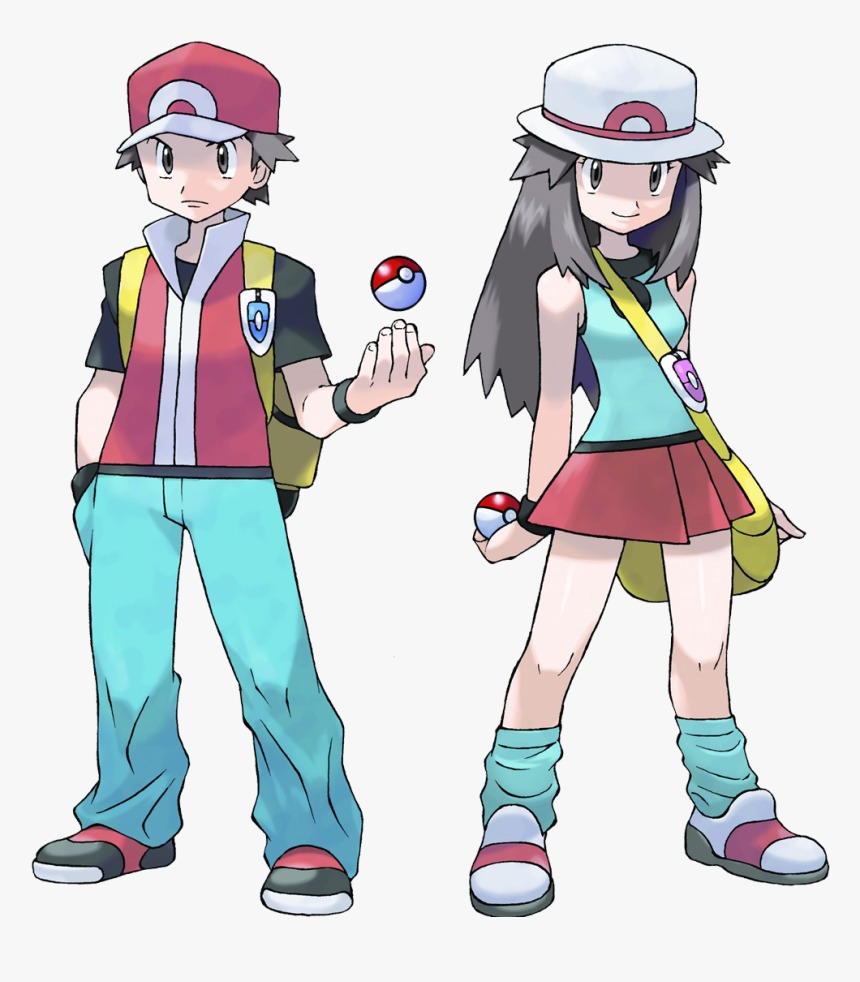
 As such the player characters got a revamp, or character should I say. Red was redesigned, now with some more details added to his jacket, hat and accessories. And a new character was added! Introducing the unnamed protagonist who never received an official name but was the second female protagonist in the Pokemon series to follow Kris in leading an example of what was to come. For simplicity’s sake, we will refer to her as Leaf, since that is what the fans have ultimately deemed her. Now Leaf is an interesting character, who sports opposite colors of Red and also opposite amounts of skin showing apparently. Where Red has extremely large pants that do not fit him at all Leaf has a fitted short skirt, that might not be appropriate for adventuring. She also sports a sleeveless shirt and a VS Seeker that color codes itself as Pink, for females, just in case you forgot, that she is female, and females like Pink, Ga

Pokémaniacal — Rivals, part 2: Barry, Lucas and Dawn

me Freak really is subtle with their identifiers. Again, it is not an issue that Leaf is wearing a short skirt, but it is in comparison to Red wearing baggy pants and a backpack, with Leaf wearing her skirt and a purse that seems to set Leaf apart as the stereotypical “female” character for “females” to immerse themselves in. These stereotypes in design would continue for a few more generations, but I wanted to go over one more.

Pokemon Diamond and Pearl released on the Nintendo DS, sporting amazing revamped graphics, new Pokemon, new tiles and of course new player characters. Dawn and Lucas are perhaps the most interesting characters we can analyze from the list of player characters, and yes it may shock you to hear but this is again another situation in which the female protagonist is shown to wear more revealing clothing than the male player character. Again we see the male characPokémaniacal — Rivals, part 2: Barry, Lucas and Dawnter with baggy pants, and this time with red shoes, a red hat, a red scarf and a blue watch. In comparison, Dawn has a pink stylized hat, with pink boots, a pink watch, a pink scarf, a purse and a dress that ends in a short skirt with pink edges. Now we see how both are wearing scarves, right? An obvious nod to Sinnoh being the coldest Pokemon region. And yet, Dawn is wearing a short dress. Her legs are revealed, and her dress is strapless? Here I think Game Freak is being very obvious in how they show the female character as always revealing more skin, as if females themselves wish to do so and wish to sacrifice comfort, and safety, for style. Lastly, to make matters worse in Pokemon Platinum we see Lucas and Dawn revamped, this time with heavier clothes! Lucas dons a heavy winter jacket, and keeps his full length pants and scarf. Dawn too gets some nice winter clothing, a full scarf and long sleeves for her…dress, that once again exposes her legs. Still. Now that Lucas is showing zero skin it would make sense for Dawn to do the same, perhaps too much sense for Game Freak though. 
 

Benjamin – Blog Post #6

As I stated in my earlier blog post it took Game Freak the creation of four games to ultimately implement a gender option for females. Pocket Monsters: Red and Green both released in 1996 with Red as the only playable character. This continued with Pocket Monsters: Yellow, Pokemon Red and Blue and Pokemon Gold and Silver. Despite entering a new generation, and revamping the other games for global release no addition of a female character was seen. Some seem to argue that this is because of the limited space available on a game cartridge, but to that I would consider how Pokemon Gold and Silver added two new typings, over one hundred new Pokemon, had two FULL sized Pokemon regions and yet they couldn’t fit in a female character option? Well in fact, they could. Because with the release of Pokemon Crystal we finally saw the introduction of Kris as the female option for those answering “girl” to “Are you a boy? Or are you a girl?”. But before we get into that, I would just like to point out how the implementation of Kris into Crystal undoubtedly shows how the female option could have easily been implemented into the earlier games. Game Freak simply didn’t prioritize it. Why? Why wouldn’t Game Freak consider an option for girls to be a girl if guys could be a guy? And why would the singular option specifically be a guy and not a girl? I think most of you kind of have a guess as I do, and I’ll likely word it a bit less nonchalant in my paper, but this is a clear example of the assumption and marketing toward men being the sole and majority of players of Video Games. 


Despite the increased number of girls playing Video Games, now coming close to equal in the modern day, most companies seem to have chosen to only market toward boys and young boys when it came to designing their games. In “No Girls Allowed” Lien discusses this stereotype of video games being for boys: “A few aisles over, in the video game section, there is a similar marketing story that Maida has yet to learn. Unlike in the toy aisles, she won’t find an expansive selection of video games for boys and an equally expansive selection for girls. Most ‘girls sections,’ if they exist, are lined with fitness titles and Ubisoft’s simplified career simulation series, Imagine, which lets players pretend they’re doctors, teachers, gymnasts and babysitters” (Lien, 2013). This example clearly shows how the gaming industry chose to market their games. The “girls section” is said to possibly not even exist, and if it does the games are completely different from those epic adventure, fighting, shooting and creation based games boys might play, rather opting for fitness titles? Though it may not relate directly to my paper on immersion I want to explore this a little bit as it should be addressed as to why there isn’t a female option in the first few games, and why Game Freak chose to wait four years at all. It would seem to me that they simply wished to market Pokemon toward a boy audience, and didn’t consider that females would even play the games at all. In the next blog post I’ll discuss Kris more in depth as the first female player character, and how her sisters in being empty characters did her dirty. 


Works Cited:

Lien, Tracey. “No Girls Allowed”. Polygon. 2013. 

Benjamin – Blog Post #5

To continue off of my last blog post I wanted to talk about some of the specifics of Pokemon Black, while relating it directly to some of the themes and ideas I’m exploring in my paper. Pokemon Black has a whole host of female characters, but I wanted to take a second to talk about Hilda and Hilbert specifically. Now, firstly, I do plan on analyzing most of the player characters before Hilda first in my paper, and have done so with Red and Gold to begin with, but seeing as I’ve had the most experience with Hilda and Hilbert I wanted to focus on them for a moment, as it directly mirrors many of the things I’ve noticed of player characters in general. 

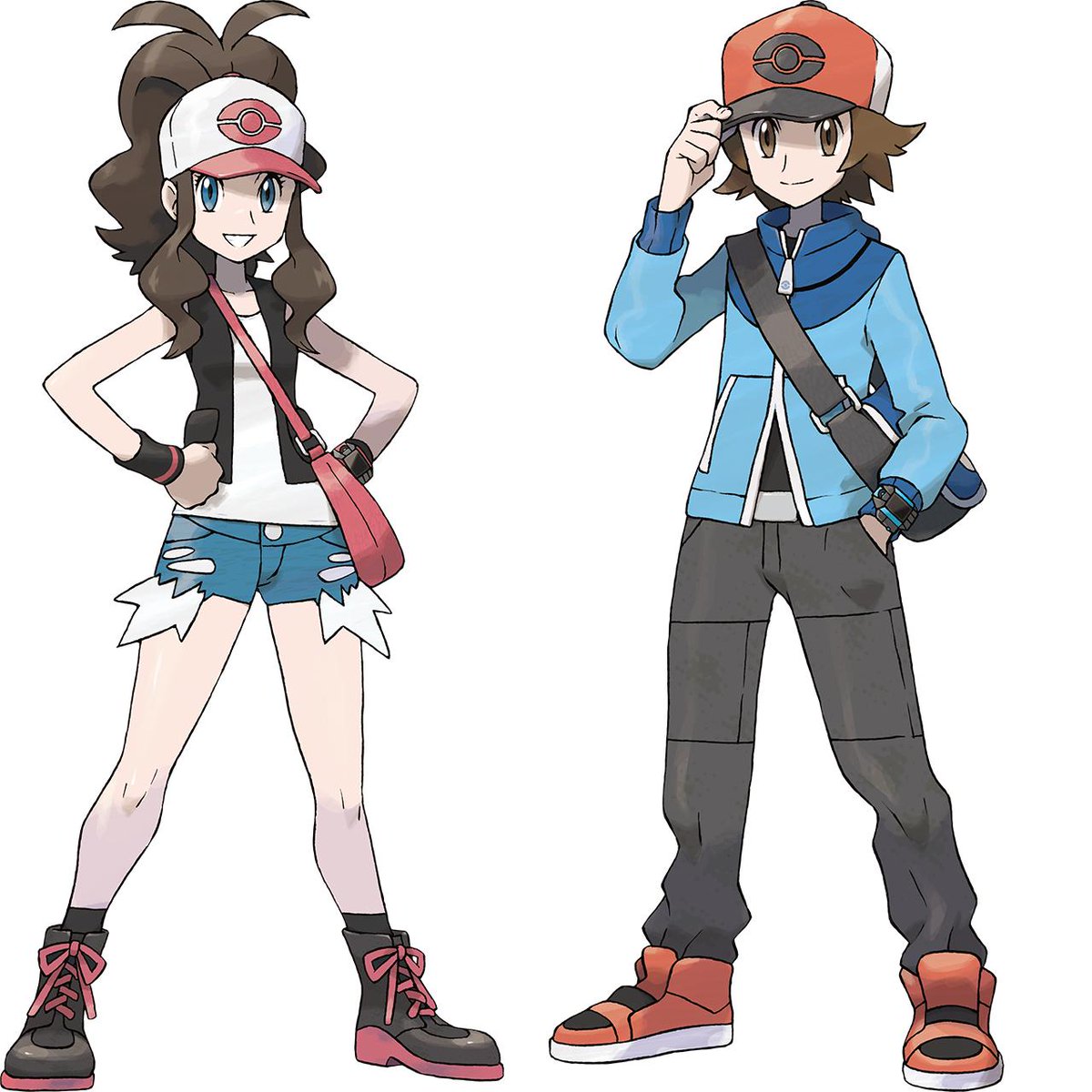
Pokemon Arts and Facts Twitterissä: "Hilda and Hilbert were ...

Hilda (left) and Hilbert (right) are the player characters of Pokemon Black and White specifically, and both are pretty different from a design perspective. Seeing as though both characters have no actual character to them, or dialogue at all for the most part, they are both vessels for the player to reflect themselves onto. However, the difference in design here is interesting. Hilbert here has plain sneakers with baggy pants, a blue sweatshirt, a blue watch, a red hat and a blue satchel. His hair is cut pretty short, as well, whereas Hilda’s is long and stylized. We see here some of the major differences in how Game Freak portrays women and men, and how at the most basic of levels these “vessels” are already preordained with some designs that seem to link directly to the stereotyped “fashions” of male and females. Despite Hilbert’s covered appearance, and most blue and red color scheme we see Hilda with short shorts, bare legs, boots with heels, pink laces, a pink hat, a pink purse and a pink watch. Thank you Game Freak, I don’t know how I would know this character is a girl if she didn’t radiate pink energy and show off her arms and legs as no boy could ever do. Now don’t get me wrong, I like Hilda. In fact, she’s my favorite player character and protagonist, and her style is amazing in various ways, but when set against the style of Hilbert, something is off. Both of these characters have little detail to them outside of their respective styles, so male and female choices should impact little in the span of your journey, and yet you need to decide between wearing baggy multilayered clothing or very little clothing at all. I feel that Game Freak designing Hilda specifically with less covering her body is meant to show us what most girls would relate to, which reinforces the stereotypes that women’s fashion sets and the pre-existing stereotype that female characters in games are meant to be some sort of “eye candy” for the male gamers. 

This trend continues with the other protagonists, and can be seen pretty early on in the series, excluding only one girl protagonist, the first girl protagonist. In the next blog post I’ll talk about Kris and how Game Freak apparently needed four years and the development of four games to create a female playable character. 

Benjamin – Blog Post #4

Today I completely finished Pokemon Black, meaning I finished the main story of the game. To begin, it is still one of my favorite Pokemon games of all time. There’s something interesting about the games in Generation 5 that is not seen in any of the other generations, and that relates directly to its plot and characters. Unlike so many other stories the story of the Generation 5 games has a lot more depth to it, and it delves deeply into some less than safe topics for a Pokemon game, such as child abuse, manipulation, and the actual morals within the Pokemon world. The conflict in the game is in fact between the player character, or in my case me as Hilbert and N/Ghetsis/Team Plasma, but there is a deeper internal conflict in the Unova region, between N and himself. Note that beyond this there may be plot spoilers, which for the most part I hope to omit from my research paper. 

N | Pokémon Wiki | Fandom

Throughout the story of Pokemon Black we see the story of our protagonist which we forge with our Pokemon team of our own creation, but we also see N stuck on a path preordained for him. Throughout the story he seems to consider truths and ideals, and his own place in the world, while ultimately questioning you, the player character, and your own motives. While playing I thought back to when I was a younger teenager playing this game, and how the question of whether Pokemon were happy with trainers had any merit. For any kid I think this question is a bit large to consider, but for the older audiences I think they can really appreciate how this explores some of the inner depth of the universe we don’t usually see. As a player you struggle with this question throughout the game while catching Pokemon, and battling them with other trainers. And N really makes it hard to dislike him, or question his own morals or principles, especially while he looks like that. Which leads me to my true topic of today, N. N is perhaps the most “feminine” male character within the Pokemon universe, with long hair, charismatic speech, and a less color coded look. Though we could all stop playing the game at the ferris wheel scene when we are finally close to N we must go on, for the deeper story is within him. 

I’m not sure if I will use this for my paper as of yet, but N’s internal struggles throughout the story of Black and White are what really help to set apart the story as a whole in comparison to other Pokemon games. He’s had a deep inner connection with Pokemon since he was a boy, and was raised alongside two girls who helped him through life. The girls, Anthea and Concordia, are also interesting characters in which they too were hinted at being abused like N. Ghetsis, the main villain of the games, has used all three children for his own means, fooling them into believing he has taken them in to help them in this world. Anthea and Concordia are the nurturing figures within N’s life, and N himself must struggle to see past Ghetsis’ lies to find the truth, while also seeking the ideals he so believes in. There’s plenty of other notes I have for Pokemon Black, but I think I’ll continue those in my next blog post. 

Benjamin – Blog Post #3

When considering the past player characters from Pokemon games as a part of my ideas for paper topics I first began to look back to the beginning. That is, the days of Pocket Monsters: Red & Green. Red, the player character and protagonist of the games was the sole player character in these games. I had played Pokemon Yellow way back when far after its release, so I brushed up on my understanding of Red as a character with a walk through of Pokemon Blue by Leuroi on YouTube. 

What I found immediately interesting of course is that I had always known that there was no female trainer character option in the original games, but I never considered the impact this might have on female players. I asked a few of my female friends about their experience with the earliest games and if it bothered them at all playing as Red. Back then it didn’t bother most of them since they were so young, but today they said it is somewhat bothersome and agreed that it somewhat breaks the immersion when playing a game as a different gender than that of which you identify with. I had my introduction. Red would pave the way for the rest of my paper from that point forward in how immersion can be broken through player characters, and what these player characters specifically represented through their designs and “character”.

I wanted to quickly note something about my paper, as I will use a word I stole from Hollow Knight to describe most of the player characters. In my notes I use the word “vessel” to describe Red, as he is quite literally an empty being with no shown emotion, desire, or actual character beyond his physical traits, much like the main character of Hollow Knight. Red however is a vessel for the player of the Pokemon games he is within. Players use Red to interact with other characters, catch Pokemon and do many other things in the universe. When I played Pokemon Yellow, I was Red, and similarly as I’m playing Pokemon Black, I am Hilda. Though the characters might have their own designs preordained I put myself in the shoes of those characters and create a type of persona for them. I believe different people like to do this differently, in which they create personas for their characters that either directly mirror their own personalities or are completely different. For me, I like to pretend I’m a badass Pokemon trainer who wishes to conquer half of the planet sometimes. Other times I like to consider myself a hero with an ulterior motive, who’s powerful Pokemon cannot be stopped by the mere grunts of some stupid evil team. Hilda as a character I can relate to in different ways. Though her design isn’t exactly what I might look like, or I might wear I can still immerse myself for the most part in being her. Whereas if I were to play as Hilbert the disgusting piece of trash that he is, I would likely have difficulty staying immersed. It is with this thinking that I continued playing Pokemon Black and taking notes on how immersed I felt I was, while also considering the female characters within the game and how I might be less immersed if I were a girl playing as a guy, or vice versa. 


I actually restarted my Pokemon journey in Pokemon Black originally. To better understand what a female who prefers a more feminine look might experience in playing the early Pokemon games as Red I had begun my adventure again playing as Hilbert, my complete opposite and frankly one of the ugliest protagonists to exist. But, I’ll discuss that in more depth later on.

Benjamin – Blog Post #2

A few weeks ago I began playing Pokemon Black Version in order to do research for my final paper. At first I had considered a few different titles such as Life is Strange, Hollow Knight and Celeste. I knew I wanted to do something that regarded the gaming community’s interaction with games, and how the game ultimately impacted those who became immersed within it. Particularly, I wanted to see how female video game players were impacted by the decisions of a company, as most games tend to make some sort of assumption that their player is a male to some extent. This somewhat ruled out Hollow Knight and Celeste for me. Though both games are amazing, they’re perhaps too amazing to critique, and they leave some things to be desired when it comes to plot critique or character critique and immersion. From there that left Life is Strange, which I had never played at all and seemed a bit intimidating to take on. 

So instead I decided to look into a series I had played all my life, Pokemon. I have always loved the Pokemon games and have always been interested in their creation, features, the companies that weigh in on decisions and why certain decisions are ultimately made. But, one thing I began to notice is that I did not look at the games through the same critical lens I did while doing my research compared to that of which I usually do. I’ve done plenty of plot analysis, and comparison of Pokemon games, dumb as that might sound, before and I think I discuss many important points the community is interested in debating. However, the ones I came upon while doing my research were different. I started to realize some of the stereotypes we’ve talked about when it comes to character creation, and how the very stereotypes I discuss through feminist theory were in front of my eyes the whole time. Short skirts, short skirts everywhere. Literally everywhere for no reason. For some reason I thought Nintendo to be above making the obvious stereotypical decisions because most of their games are geared toward a younger audience.

Anyways, I began playing Pokemon Black and started to take note of some of the interesting interactions within the game, particularly with female characters. One of the things I noticed before I even began playing was the age old question “Are you a boy? Or a girl?” It somewhat struck me how I could start to forge a paper over the lines as the entire Pokemon community seems to know them by heart, to the point they’re somewhat of a meme or a joke within it. I was interested in how Pokemon, to this day, sets gender up as a binary, between male and female, wholly separate with no other option. However I ultimately decided that I would stick with the idea of focusing on the female character, and how female players might interact within the game and immerse themselves. But, I planned to use this line and its context to focus specifically on the player character, as that is the most direct way in which the games affected the immersion of their players.

Benjamin – Blog Post #1

This week in class we discovered quite a bit about in game identity, and what it means to customize a character in a game. When I set about creating my character in World of Warcraft I had originally thought to simply look for why certain options were missing, but I slowly began to take notice as to why I made some particular decisions in regards to customizing my character.

What I considered most when customizing my character was the idea of “sameness identity” from Adrienne Shaw’s “He Could Be a Bunny Rabbit for All I Care! How We Connect with Characters and Avatars”. In it Shaw states how “sameness identity describes feeling that one has become or is the character–sameness identity refers to the way games make players think about their actions in terms of themselves rather than in relation to characters in the text as separate beings” (Shaw). Though I only went through the customizer and didn’t actually interact with other characters or story I viewed my character as me, and not a separate entity I simply controlled.

When it comes to my decisions in terms of customization I tried to consider why I made the decisions I did, some of these were easy to trace back, while others were more difficult.

“Sunset”, my character from World of Warcraft

The first aspect of my character I chose was its “faction” which was essentially its species. As to why I chose a member of the Draenei, well its rather simple. When I think of myself being a human I think of all the problems humans have caused, and how flawed we are, so I prefer to think of myself in game as something “other”. Then of course there was gender, which there were only the two options, male and female. When it comes to gender I am not usually conflicted, I always choose the female. Why this is I had to think about though, and it goes deeper than the stereotypical “females are nice to look at” or “I wish I were a female”. Gender, in and of itself, I view as a social construct. We’ve limited ourselves to particular fashions, looks, accessories, jobs, responsibilities and such all because of simply…sexual parts. I do not wish to be of the female sex, I am fine being of the male sex, but I do not wish to conform to the limitations of the male gender. Therefore I often choose the female gender in games, not to go against the male gender but to look beautiful, and accessorize as I please, which is often only an option as a female character.

With hair color, face, horns and hair style I didn’t think  too much about it, I just thought what looked most like how I would like to view myself in a mirror. I think the end result is something that somewhat mirrors me in a fantasy world, though the breasts are a bit too circular and large for my liking.

Overall my interaction with the character customizer in World of Warcraft was interesting, I felt that the choices offered were very limited, and that the options for different genders were missing. Additionally the gender choices seemed to fit the two binaries of what “male” and “female” are defined as through looks, and the difference in armor for women was a bit unsettling in how it showcased the breasts on most of the female characters, but that’s a discussion for another time.